Me and EQ

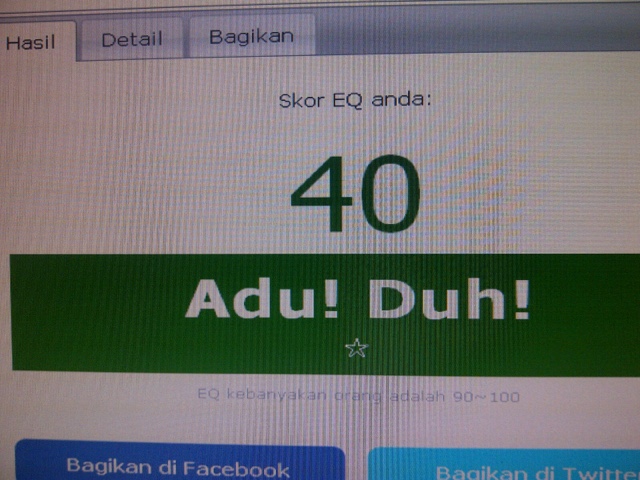
I was browsing on Internet about EQ and I found an online test on that. I took the test and the result is quite funny.


So today I'm gonna talk a little bit about EQ, it has been a discussion between me with my friend on this subject few days back. I'm myself have low EQ, I know I'm 36yo but the concept of thinking like adult is confusing me. 

So Its not just once I get a shout from my friend saying GROW UP or how old are you, r u sure ur 36 u think like 15yo. I mean its easy for them to say grow up but to me Its really hard, grow up doesn't have manual book n it did not teach at school. 

I really have hard time in social event cos I don't know how to talk to people. I happen to have good grade at school but EQ doesn't have anything to do with that, its not 1+1=2. We meet many different person and each require different approach, that's what I can't handle. 

So I don't make much friend in my live but recently I read that we can develop EQ because its not something you can't change. U can learn and train ur emotional self to be better for your life, career, and for interact with other people. This really excited me, well honestly I used to feel that I don't wanna live my whole life like this, I like people and I love to talk to them so this new insight really bright up my world. 

So EQ let's make you rocks. I've read some of blog that discuss about this and here is few things that need to do for our EQ.


Here are 10 Ways to Enhance Your Emotional Intelligence:

1. Don't interrupt or change the subject. If feelings are uncomfortable, we may want to avoid them by interrupting or distracting ourselves. Sit down at least twice a day and ask, "How am I feeling?" It may take a little time for the feelings to arise. Allow yourself that small space of time, uninterrupted.

2. Don't judge or edit your feelings too quickly. Try not to dismiss your feelings before you have a chance to think them through. Healthy emotions often rise and fall in a wave, rising, peaking, and fading naturally. Your aim should be not to cut off the wave before it peaks.

3. See if you can find connections between your feelings and other times you have felt the same way. When a difficult feeling arises, ask yourself, "When have I felt this feeling before?" Doing this may help you to realize if your current emotional state is reflective of the current situation, or of another time in your past.

4. Connect your feelings with your thoughts. When you feel something that strikes you as out of the ordinary, it is always useful to ask, "What do I think about that?" Often times, one of our feelings will contradict others. That's normal. Listening to your feelings is like listening to all the witnesses in a court case. Only by admitting all the evidence will you be able to reach the best verdict.

5. Listen to your body. A knot in your stomach while driving to work may be a clue that your job is a source of stress. A flutter of the heart when you pick up a girl you have just started to date may be a clue that this could be "the real thing." Listening to these sensations and the underlying feelings that they signal will allow you to process with your powers of reason.

6. If you don't know how you're feeling, ask someone else. People seldom realize that others are able to judge how they are feeling. Ask someone who knows you (and whom you trust) how you are coming across. You may find the answer both surprising and illuminating.

7. Tune in to your unconscious feelings.How can you become more aware of your unconscious feelings? Try free association. While in a relaxed state, allow your thoughts to roam freely and watch where they go. Analyze your dreams. Keep a notebook and pen at the side of your bed and jot down your dreams as soon as you wake up. Pay special attention to dreams that repeat or are charged with powerful emotion.

8. Ask yourself: How do I feel today?Start by rating your overall sense of well-being on a scale of 0 and 100 and write the scores down in a daily log book. If your feelings seem extreme one day, take a minute or two to think about any ideas or associations that seem to be connected with the feeling.


9. Write thoughts and feelings down. Research has shown that writing down your thoughts and feelings can help profoundly. A simple exercise like this could take only a few hours per week.

10. Know when enough is enough. There comes a time to stop looking inward; learn when its time to shift your focus outward. Studies have shown that encouraging people to dwell upon negative feelings can amplify these feelings. Emotional intelligence involves not only the ability to look within, but also to be present in the world around you.

I'm willing to try, how about you?

Comments

Popular Posts